21 KiB
| title | date | abstract | tags | status | confidence | importance | scope | novelty | practicality | |
|---|---|---|---|---|---|---|---|---|---|---|
| About Levi Neuwirth | 2026-03-16 | An extensive introduction to who I am, what defines me, what I do, tools I use, etc. For a more concise, professionally formatted synopsis, see the Biography page linked from the site index. |
|
Draft | 90 | 2 | personal | moderate | high |
How does one resolve the age-old dilemma of earnest self description? Is any such act of description overly humiliating and reductive in nature? Hubristic and egotistical, on the contrary? I have pondered over this subject for years, my greatest conclusion being that my actions and character should be the pinnacle of how I am described, for these form the pinnacle of what constitutes me.
I understand that this presents an issue: casual surfers of this website, curious readers of my research or other output, and even, believe it or not, myself, for my own personal reference on sporadic occasion, would benefit from an attempted summary in words of who I am. I am obliged to deliver, and such a summary follows.
Basic Traits
I have always thought that the defining characteristic of what makes Levi Levi, in so far as I or anyone have such a thing^[My chief concern throughout this document, as established in the introduction, is establishing a balance between reductivity and egotism. The broader conclusion I have come to? Human lives and persona cannot be mapped onto human language. Interesting!], is the combination of my curiosity and creativity. This is not a curiosity that manifests purely in the abstract. I am certainly interested in abstract things, rabbit holes, all-nighters composed of study, you name it - but I am equally curious in a more tangible sense, one that invokes the process of creation. Much of the substance of my life has been the result of various incarnations of this latter form of curiosity combined with a creativity whose origin I cannot explain. In a concise way, I could state it as follows: I generally feel a strong urge to produce and put my own spin on anything that I consume.
Greatest Strength and Flaw
The realization of this curiosity/creativity complex yields what I find simultaneously as my greatest strength and my most detrimental flaw. I can be relentlessly ambitious and work persistently towards goals that others might dismiss as too far-sighted, impossible, etc. - but I also consistently bite off more than I can chew and overwork myself. I'm at least aware of the latter fact and try to counter it by introducing work that I enjoy, such as work on this website!
Personality
For what it is worth, I am an INTP. Whether or not this means anything is up to your interpretation. In other, perhaps more grounded descriptions (ie those from my fellow humans) I am usually thought to be neither overly optimistic nor pessimistic, one of those introverts who is really an extrovert with a limited social battery, a particularly animated and energetic person when the focus is something about which I care, and often I am found to be deep in thought (or mental composition of music).
Aphantasia
I have complete aphantasia, which means that I cannot visualize anything in my mind. My mind works entirely off of linguistic and indescribable "visualizations." This has had a profound impact on my life. I did not realize that others could visualize actual images in their mind (I thought that when people spoke of this, they were being highly metaphorical and or poetic) until I was in high school.
I believe that my aphantasia is the reason that I am so affected by words (both in prose and poetry) and music as not only mere artistic forms but means of utmost expression. I do not think that I would find such necessity for creative expression through these means without my aphantasia, and as such, I prefer living with aphantasia to living the normal way.
Favorites
[I GENERALLY DO NOT HAVE A FAVORITE X OR Y.]{.smallcaps} I take two primary issues with the notion of "favorite" as it is used in coloquial American English: first, that one's "favorite X" is often conflated, whether explicitly or implicitly by said one, with "the best X." For any instance where I do have have a favorite, I do not make any assertion that my favorite X is necessarily the best X out of all possible choices of X. Second, I believe that the action of selecting a favorite is inherently reductive and forces comparisons that are invalid. We are not computers, and we should not be organizing everything into tensors for comparison and floating point operations. Let us enjoy diversity and variance for what they are rather than try to reduce everything to a mere favorite!
The one exception
With this said, there is one major exception, and that is my favorite book: The Brothers Karamazov, by Fyodor Dostoevsky. I cannot understate the impact that this book had on my life, and it is thus my favorite; I carry it with me essentially at all times, and reread at least some section of it nearly every day.
Education
University
I am currently finishing my senior year at Brown University, from which I will graduate with degrees in Mathematics and Computer Science in May. This autumn I will begin my graduate studies in Computer Science. I chose these areas because their generality and broad interaction with abstraction captivated me in a notable way. This fact is still true to this day - I have never felt significant burnout, nor felt that I had exhausted some finite supply of interest and curiosity in my chosen fields.
Autodidacticism
The bulk of what I have learned has been on an individual basis rather than in affiliation with some institution. This is merely a personal preference; I do not think that autodidactic learning is uniformly intrinsically better, nor do I believe that is necessarily more efficient or otherwise superior to learning through an institution. It is simply what I have always known works for me, and my intuition in this regard has been substantiated by years of empirical evidence.^[Read: progressing through the formalisms of various educational institutions. My grievances are primarily with the public school system that I endured for 13 years of my life, in which autodidacticism was actively perceived as contrary to the goals of the institution, whereas autodidacticism is essentially implied at the University level, or, at a minimum, at a University as rigorous at Brown.]
Study Habits
A core element of my autodidacticism and one that I write about with frequency is what I call metalearning - the notion that frequent study of how to study itself is a worthy, if not necessary, undertaking. To this end, I try to keep my own study habits somewhere at the midpoint between the relevent cognitive psychology literature and my own intuition of what works best for me.
I broadly adopt technologies that assist me in learning, and generally do so without reservations. I believe in the capability of (ethically designed and well-intentioned) technology to augment the power of human intellect. I firmly believe that the technologies that I use, both the ones that through societial usage are taken for granted, and those that are perhaps more novel, strongly augment my ability to think, learn, and create. The key word in the previous sentence is augment, and the delineation between augmentation and automation is a crucial one. I will not use technologies such as Generative AI to automate away my cognitive processes. I believe that synergistic augmentation is the way forward in the current age of much technological excitement, rather than automation with subsequent deprication of what it means to be human.
Computer Science and Mathematics
I fell in love with computation at a young age. I have been fascinated, inspired, and motivated by the beauty, elegance, and universality of the subject for as long as I can remember. In elementary school I was writing basic programs and text-based games. In high school, I tried to write programs to do my homework, albeit in Java. I recall successfully implementing a statistical suite from scratch with nothing but java.util.Scanner, and, later, failing to successfully write a program to do my tedious AP Calculus homework.
I fell in love with Artificial Intelligence during my first semester at Brown. My first computer science final project was to write an implementation of generalized Connect 4, including an AI player. The AI player was simple, and "AI" in this context refers to the grand scheme of the field, not the coloquial usage referring exclusively to large language models / generative models. After much hard work, when I finished the project, I decided to see if my creation could beat me in a game of Connect 4. (I had studied previously some strategies in Connect 4, in the hopes of consistently beating my high school friends, so I was fairly confident in my abilities being above-average.) Needless to say, my creation immediately defeated me decisively. The next morning this result was reproduced several more times. This absolutely amazed me, and provided me with an undying capitvation that has yet to be exhausted.
Mathematics and I have a more complicated history. I always loved mathematics in school, yet it was consistently the lowest grade on my report card. Where I really fell in love with mathematics was when I began to learn algebra and venture into the realm of the abstract. The idea of a function was captivating to me as an 8th grader. (It is still captivating to me to this day, somehow.) I entered Brown thinking that I preferred and intended to study physics, but quickly learned that the mathematics underneath the Physics was what I truly enjoyed. In my sophomore year, I "hopped down the street", so to speak^[Kassar House, home of Brown's department of mathematics, is just down the street (George Street, to be precise) from Barus & Holley, which used to be most notable as the home of the physics department.] and haven't looked back since.
I have long said to friends that one does not "do mathematics," but rather "mathematics does you," and this encapsulates how I feel about mathematics better than anything else I can think of at the moment. Mathematics is endlessly creative and has, to me, unlimited intrigue. I vividly remember learning about the Sylow Theorems in my 3rd semester abstract algebra course - my first math upper level - and feeling a sense of absolute wonder and beauty at the proof, yes, but moreso at the grandeur of human genius - that we were able to derive this result, and so many subsequent ones, and that I had the power to understand it just the same!^[Which was perhaps not evident based off my score for the final exam of that course, but I digress.]
Computer Systems
I have been interested in the low level since I began to study computation. Getting closer to the hardware was a constant goal as I learned Java in high school. Later, when I took my first real "Systems"^[Brown makes a real distinction about what is "Systems" and what is not "Systems", much more so than I would. But, the effect of having your undergrad take place within a particularly semantically concerned department sticks.] course, I felt like I was a wizard, learning the ways of some magic. Computers are wonderfully beautiful and powerful machines, and the systems that they are are nothing short of exquisite. Many folks seem to think that those of the system-minded type are some hardcore, late-night hacker type devoid of social life, romance, etc. I think quite the opposite: those of us who love systems love beauty and elegance, and those who opt to write Javascript whilst blatantly refusing to learn about how the systems they use work are the ones with deficits to fill!
Music
Music is core to who I am. I have played trumpet, my primary instrument, for the majority of my life. I also play piano, horn, trombone, euphonium, tuba, and a bit of drums. More important to me than playing, however, is composition. I feel that my compositions are fundamentally a part of me, an extension of the person that I am.
Composition
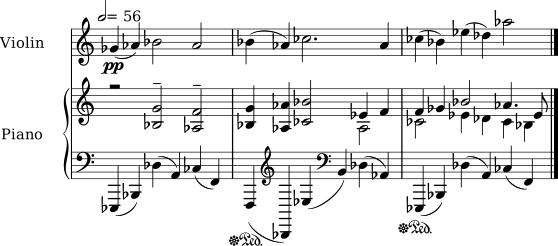
::: {.score-fragment score-name="Violin Sonata - III (2021)" score-caption="A short excerpt from the third movement of my Violin Sonata, composed in October 2021."}
 :::
:::
::: dropcap COMPOSITION [IS]{.smallcaps} PERHAPS MORE THAN ANYTHING ELSE THE PRACTICE [OF MY]{.smallcaps} LIFE. I say these strong words because I feel strongly about this process. Composition uses the entirety of not only my mind and my intellectual power, but also the entirety of my essence. When I am immersed in a composition, I am the composition, and the composition is me. We are wholly isomorphic. Thus, my compositions function in many manners: they are time capsules, they are personifications, or, if you like, anthropomorphisms of some sort; they are expressions of the Universe, or whatever you prefer to call them. They are, and they will continue to pour out of me, because as far as I can tell, it is by my pen that my life is defined. :::
Music composition is thus chiefly distinct from other forms of creative activity for me. Music is the most rewarding for me, invoking the most passion, and it is the medium by which I feel I have the most expression potential and the most capacity to express.^[These are two different things for me. By expression potential, I mean the range of sentiments and ideas that music can, in the abstract / in principle, express. This expression potential is thus innately provided to me by mere virtue of my partaking in the act of writing music. By capacity to express, I am referring to my own personal ability as a composer to successfully express that which I intend to rather than the full range of what music itself might be able to encapsulate.] When I hear a composition that I have finished it surmounts me and effortlessly transports me into an immersive state; I am returned to the deep feelings and profound^[Not necessarily in grandeur, but in personal depth.] ideas that I tried to capture through my project. On the contrary, music also torments me. I am something of a perfectionist with my compositions and get frustrated when they do not pan out the way I intend. I scrap many projects that I perceive as insufficient, and when ideas are not flowing, I suffer for it. Luckily, since composition is such a core constituent of who I am, I have found a consistency in my undergraduate years, and the ideas have generally flowed without significant pause since 2023. I can only hope for my own sake that this trend continues far into the future.
::: {.score-fragment score-name="Flute Sonata - I (2026)" score-caption="A short excerpt from the first movement of my Flute Sonata, composed in January 2026."}
 :::
:::
Interests
I have many interests, and while they can be temporarily all-consuming, I try not to let any singular interest of mine define me.^[In the past I allowed myself to be more "defined" by my passions, at least in my self-image. (I can't control how you define me, but I can control how I define me, after all, and that is to me the most important definition.) These days I believe that if such an all-encompassing definition is necessary it must be built from a higher level of abstraction than any singular interest - rather, what are the specific qualities that are brought to any interest? It is not the fact that I do many things but the manners in which and reasons for which I do them that should be the basis of the definition. Exiting Modernity talks at great length along these lines.] (The distinction I am making between "interest" and "passion" should be apparent here.) Some of my interests are chiefly sporadic; every once in a a while (a while might be a month, a year, etc.), I find myself immersed in and unable to escape the interest for a week or two. Other interests are more constant in my life. My foremost interest is perhaps a metainterest - I'm interested in increasing the variance within my life's experiences, and thus interests that are iterative and provide me the opportunity to do previously unknown things and expand my horizons are generally the most potent to me.
Foreign Languages
I am extremely interested in Foreign Language, and most fortunate to be a native speaker of English, given that I grew up in the United States. This awards me the privilege of having access to a wealth of materials in my mother tongue for learning just about anything, including just about any language. The study of languages other than English is an absolute constant in my life; it has been for years and will persist for many more! I will mention a few important ones here.
Spanish
During the last five years of my time in public high school, I took 5 courses in Spanish - the first two were required, and the latter three were pseudorequired - New York State requires only a basic Spanish credit for graduation, but to have any true competitive college application, one really must take a foreign language throughout. Regardless of this fact, my time in public high school taught me essentially no Spanish. Rather, I decided that learning Spanish was worth my time in my senior year, after our class ranks had been finalized, yielding a lighter workload as a result. During the day for the rest of the year until I graduated, whenever I had free time or nothing worthwhile to do, which was often, I would read exclusively in Spanish. I made an effort for the first time to immerse myself in Spanish and it worked well. This was the moment that I fell in love with the process of learning languages.
Chinese
During my first year at Brown I took Mandarin Chinese. It was a great challenge compared to Spanish, and I enjoyed it as such. I regret that I have not had time to keep up the practice since - I intended to continue into third year Chinese and beyond, but unfortunately my schedule became to busy for that intention to become reality. Mandarin is, perhaps curiously, though perhaps not so curiously, the only language I have ever studied where reading was not the easiest skill for me to acquire. (In fact, for Mandarin, it was the second-hardest, only after writing.)
Danish
I entered 2024 having absolutely no intention of learning Danish, and left it conversational. This happened because I studied abroad in Copenhagen for the second half of the year and fell in love with the city, the country, the culture, and, yes, the language! Danish, along with German, is one of my focuses as of now (2026).
German
I decided to make a push to learn German, which I had long intended but never taken action toward, in late 2025. The diversity of philosophers whose primary language was German was a great motivation for this. My own aspirations of spending some extended time in Germany were also an inspiration, as were my fond memories of Berlin from my visit in 2024. I have quickly fallen in love with German this year, and intend to make my German better than my Spanish. I anticipate relative fluency by the end of the year 2026, and only improvement from there.
Linguistic Bucket List
I have long had some notion of a "Linguistic Bucket List" - a collection of languages I intend to learn, whether for literacy or for true fluency over the course of my life. A subset of that follows:
- French. French is 100% the next language I will learn after my German is at a level such that study becomes more passive.
- Russian. The literature is exceptional, and thus I feel obliged.
- Latin & Greek. I am interested in reading the ancient texts in these languages, and perhaps pursuing Greek further, as it is part of my heritage.
- Sanskrit & Pali. I am also interested in reading the ancient texts of these languages.
Naturalism
I am fascinated by and interested in flora and fauna of all types, but as for the latter, birds and herps are especially intriguing to me. I have a lot of broad aspirations for this, but there always seems to be too little time to see them all the way through.
Running
My sport of choice these days is distance running. I am particularly fond of trailrunning, but more frequently run on roads, trails, or, most regrettably (though only when absolutely necessary), the treadmill. I find running to be a juxtaposition of soothing and exhilarating. Watching the sun rise over the various bays and beaches of Rhode Island is incredibly soothing. Working your way straight up a ridge of bedrock in the midst of a heat wave is absolutely exhilarating.
I don't use strava, nor an electronic watch, nor do I really pay much attention to my times. This takes away from what is to me the great joy in running - being disconnected, in tune with my thoughts and my bodily perceptions, and enjoying the only moment that there is - NOW.